Danielle Hanosh
Until recently, there have been few opportunities for children and teenagers to gain hands-on leadership training grounded in empathy, anti-speciesism, and environmental responsibility. Leaders for Ethics, Animals, and the Planet (LEAP), a nonprofit created to fill that critical gap, now offers a compassionate and forward-thinking alternative to traditional agricultural youth programs in the U.S. and Canada.
Built on a foundation of collaboration, inclusion, and integrity, LEAP empowers young people to become thoughtful, well-informed changemakers who understand the interconnectedness of climate solutions, plant-based living, and human and animal rights. At vetted animal sanctuaries, LEAP students participate in monthly classroom lessons, hands-on workshops, vegan cooking and nutrition education, leadership training, and service projects that meaningfully impact both their local communities and the animals and ecosystems they strive to protect. Lesson topics range from animal sentience and anti-speciesism to biodiversity loss, climate anxiety, and practical plant-based living skills.
The experiential nature of LEAP is one of its greatest strengths, as students spend time in nature, directly caring for rescued farmed animals, assisting with sanctuary operations, participating in conservation-focused projects, and learning to advocate confidently for animals and the planet. For many, this immersive experience deepens their empathy, strengthens their understanding of ethical food systems, and inspires long-term lifestyle change.
But LEAP’s impact extends far beyond sanctuary life. Students build strong leadership and public-speaking skills, participate in campus and community activism, design far-reaching service initiatives, and develop a “personal code of ethics” they carry into adulthood. Program graduates have gone on to join the Youth Advisory Council where they launch advocacy campaigns; many are pursuing animal-oriented career paths and influencing family and community perspectives about food choices and compassionate living.
Perhaps most importantly, LEAP is creating a generation of young leaders who refuse to accept harmful traditions as inevitable. They challenge cultural norms rooted in speciesism, question the stories society tells about animals, and show through their actions that a different future is possible.
As the program expands in 2026 from sanctuaries to classrooms, after-school clubs, and community centers, its ripple effect grows stronger. Empowered youth are finding their community, their voice, and transforming their peer groups, families, campuses, and workplaces with a message of strength in kindness.
STUDENT FEATURES
L – Leadership: Stefano Grappo
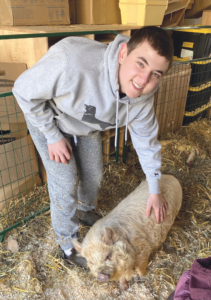
For 11th-grader Stefano Grappo of Holliston, Massachusetts, leadership begins with honesty, initiative, and the courage to model compassion. A LEAP 1 (first year) graduate and current LEAP 2 participant, Stefano has contributed more than 200 volunteer hours to feeding, caring for, and maintaining enclosures for rescued farmed animals at Unity Farm Sanctuary in Sherborn, MA. His dedication to hands-on service has shaped not only his understanding of the animals he helps, but also his emerging identity as an advocate.
Stefano describes LEAP as transformative: a source of education, empowerment, and personal growth. “I have gained tremendous knowledge around how to stand up for animal rights,” he explains, noting that the program has helped him both reduce his own consumption of animal products and support others in doing the same.
Leadership, to Stefano, is not about authority, but about example. “Leadership means taking initiative and expanding not only my knowledge but educating and helping others and being a role model,” he says.
His LEAP teacher at Unity Farm Sanctuary, Jennifer D’Angelo, describes him as a student who brings “refreshing honesty and a sense of humor” to the program, along with an eagerness to make life better for these previously farmed animals.
As Stefano continues his second year in LEAP, he embodies what the “L” in LEAP represents: young people stepping forward bravely, compassionately, and creatively to lead their communities toward a kinder world.
E – Ethics: Harper Garrison
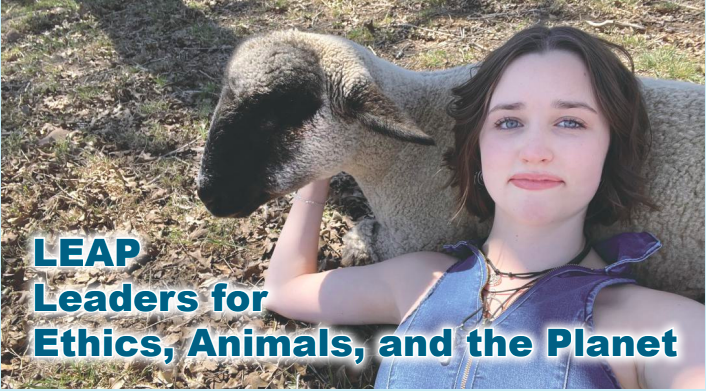
For Harper Garrison, a 17-year-old senior from Austin, Texas, ethics is not an abstract idea, but a daily practice. As a LEAP Year 1 student, Harper has already become a powerful voice for animals, channeling her compassion into advocacy, outreach, and community action. Her journey with LEAP began in a moment of urgency: she was trying to save her sheep, Onion, from a Future Farmers of America (FFA) contract where she would be sent back to a farmer to be used for breeding before being slaughtered. When Harper contacted LEAP’s cofounder Danielle Hanosh for advice, Harper found not only the support she needed, but a community that would transform her life. (photo of Onion and Harper together at top of article)
Since joining LEAP, Harper has participated in an impressive range of activist and volunteer projects. She worked with peta2 on their Thanksgiving Vegan Roast Giveaway, assisted with animal advocacy outreach at a B-52s concert, and was featured on the Animal Friendly Podcast. She also received the peta2 Compassion in Action Award and the Youth Pro Animal Award from Pro Animal Awards for her bravery and determination. Currently, she is lending her voice to the LEAP Youth Advisory Council and planning a fundraiser for Austin Farm Sanctuary where Onion resides, a testament to her initiative and growing leadership skills.
Harper describes LEAP as a catalyst for confidence, community, and clarity of purpose. “The program genuinely changed my life,” she says. “LEAP gave me the confidence to speak up for animals, introduced me to compassionate, driven students, and taught me more about animal rights than I ever could have imagined learning in school.”
Through hands-on experience at Austin Farm Sanctuary, Harper has strengthened her commitment to animals, noting, “I stopped eating animals years ago because of the environmental impact of agriculture, but LEAP deepened that commitment. I (am participating) in the program at Austin Farm Sanctuary where I meet animals from all kinds of backgrounds. Seeing their unique personalities up close reminds me of why my choices matter. LEAP also gives me a community that supports veganism in a way people in my everyday life often don’t.”
When considering LEAP’s letter E for Ethics, Harper offers a thoughtful, grounded definition: “Ethics means looking at the impact of my actions, not just my intentions.”
Harper’s perspective embodies the heart of LEAP: a commitment to thoughtful, compassionate choices that ripple outward into meaningful change. She wants others to experience the program, saying LEAP has “…opened doors I didn’t even know existed. No matter what someone’s goal is, whether that be advocacy, community, or education, LEAP works alongside you to help you grow. That’s why I encourage everyone to join and see what they’re capable of!”
A – Animals: Siri Kaelin
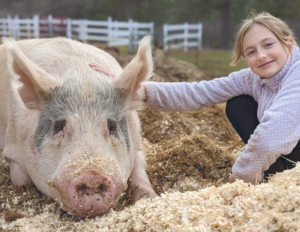
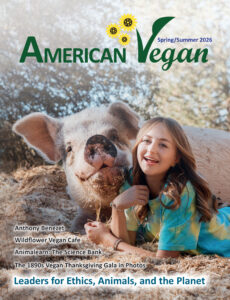
For Siri Kaelin, a 16-year-old 10th-grader from Folsom, California, on our cover, animals are neither abstractions nor commodities, but teachers. Over the past six years, Siri has volunteered at Blackberry Creek Farm Animal Sanctuary nearly every Friday after school, assisting with cleaning, events, animal care, tours, new volunteer training, and community programs. Her long-term commitment to both veganism and caring for the animals has given her a deep understanding of sanctuary life and an intimate connection with the individuals she serves.
Now, as a Year 1 LEAP student and member of the Youth Advisory Council, Siri has embraced the opportunity to expand her knowledge of ethics, critical thinking, and animal protection. “The LEAP program is valuable not only for teaching young people where our food truly comes from, but also for helping us explore our own ethics and values,” she says.
Siri was already vegan for ethical reasons when she joined LEAP, but the program has deepened her confidence and strengthened her commitment to that choice. Through lessons about global food systems, animal agriculture, wildlife conservation, and the environmental impacts of food choices, she developed a richer understanding of how her lifestyle protects animals and the planet. “The things I have learned during my time in LEAP will be lessons I can take with me for years to come,” she explains. “The program also connects us with a supportive community of like-minded peers who share similar values, making it easier to stay motivated and confident in living a vegan lifestyle.”
When asked what “Animals” means to her, Siri speaks with profound sincerity. To her, animals embody authenticity, emotional depth, and unspoken wisdom. She describes the comfort of a dog’s exuberant greeting or the quiet grounding of a cow resting their head in her hands. She notes that “…animals seem to understand emotion as deeply as humans do, and sometimes even more. Each creature has their own unique personality, no two alike, and their ability to love without judgment reminds me what genuine empathy looks like. They feel without pretense, forgive without hesitation, and offer comfort without expecting anything in return. Their presence encourages me to slow down, pay attention, and connect more meaningfully with the world around me. When I spend time with animals, I feel grounded — reminded of the simple, honest kind of love that exists all around us if we take the time to notice it.”
P – Planet: Mila Rodriguez
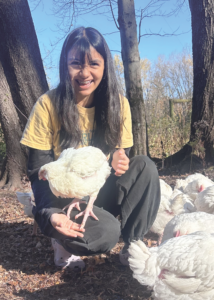
At just 15 years old, Mila Rodriguez of South Amboy, New Jersey, already speaks with clarity and conviction about environmental stewardship. A 10th-grader, graduate of LEAP 1 at Tamerlaine Sanctuary in Montague NJ, and current member of LEAP’s Youth Advisory Council, Mila has spent years volunteering as a sanctuary camp counselor, festival assistant at the “Flocktober” Fest, and participant in rescue operations. Most recently, she aided in the Kaporos Rescue alongside her mother, saving over 80 chickens, caring for injured birds through the night, and supporting their recovery and placement: challenging work that reflects both compassion and resilience.
LEAP has been a meaningful source of education and empowerment for Mila. She notes that the program has deepened her understanding of animal behavior, environmental issues, and the far-reaching consequences of human choices. “Learning about the ethical and environmental issues that affect animals has helped me see how greatly human actions impact them and the planet as a whole,” she explains.
For Mila, the letter P in the LEAP acronym means caring for the planet and honoring the shared home of every living being. Having grown up vegan, she learned early how food choices affect ecosystems, climate, and animal life. Over time, her understanding has evolved from practical awareness to a deeper sense of sacred responsibility. Her belief is simple but powerful: protecting the Earth is essential because “it’s the only home we all share.”
Mila aspires to be a veterinarian and is currently developing a YouTube show through LEAP’s Youth Advisory Council, which will feature veterinarians offering education and insight to young aspiring vets around the world.
Through her work with younger children and sanctuary animals, her participation in rescue work, and her Youth Advisory Council service, Mila models what environmental leadership can look like in daily life, compassionate choices, informed action, and the willingness to show up for beings who cannot advocate for themselves. Her voice, like those of her fellow LEAP students, offers hope for a future shaped by thoughtful, ethically grounded youth who understand that caring for animals and caring for the planet are inseparable.
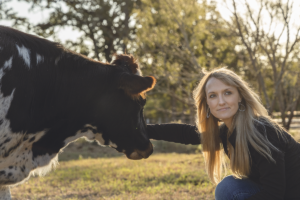
Danielle Hanosh is the cofounder
and executive director for LEAP
LeapForAnimals.org
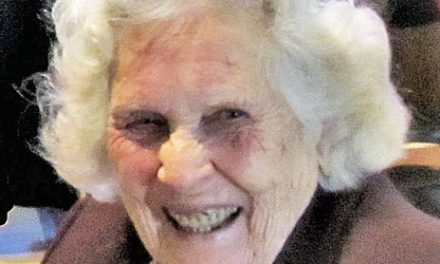
Front cover photo: Cromwell Pig with Siri Kaelin at Blackberry Creek Farm Animal Sanctuary, photographer Courtney McArthur. Photo top of article: Onion Sheep relaxes with Harper Garrison who saved Onion from FFA when they exited the program together. Onion now lives at her LEAP host sanctuary, Austin Farm Sanctuary; photo by Harper Garrison. Tofu Pig with Stefano Grappo, photo courtesy of Unity Farm Sanctuary. Percival Pig with Siri Kaelin; photo courtesy of Blackberry Creek Farm Animal Sanctuary. Mila Rodriguez is at Tamerlaine Sanctuary with hens from a recent Kaporos rescue she helped with in NJ. The hen on Mila’s lap is Stella; photo by Paola Gavino. Danielle photo with Maggie Cow at Austin Farm Sanctuary, photographer Molly Condit.
This article originally appeared as the cover story for the Spring/Summer 2026 issue of American Vegan magazine.