“If it wasn’t for The Science Bank program, I wouldn’t have been able to
influence my high school to try alternatives!” —Livia Aschheim
Have you ever dissected an animal in school? Live and dead cats, dogs, frogs, farmed animals, and many other creatures are commonly used as exploratory lab tools in K–12 and higher education institutions. Animalearn, the humane science education program of the American Anti-Vivisection Society, works to end animal use in education through its free humane science alternatives loan program, The Science Bank.
This year, The Science Bank proudly celebrates thirty years of providing humane, nonanimal resources for science courses at all education levels. In 1996, when first launched, it offered around one hundred types of science alternative products. It also gave students who wanted to opt out of dissection labs a way to learn without harming animals.
The Science Bank is the only loan program of its kind in the U.S. It now offers hundreds of alternatives, from realistic models to augmented reality (AR) and virtual reality (VR) tech tools. These materials have been used by thousands of educators, students, and parents, providing important solutions for anyone seeking effective nonanimal methods for teaching and studying science.
One such product is the Kind FrogTM, a new dissectible model popular with science teachers as an alternative to frog dissection. The Science Bank also worked with Shy 38 Inc. farmed animal sanctuary and United Poultry Concerns to develop and offer a free humane chick-hatching alternative called The Hatching Kindness Project.
Borrowing materials from The Science Bank is a simple three step process: borrow, learn, return. Individuals can search for alternatives by animal type (including human), education level, medium, manufacturer, and subject level. It also offers a comprehensive list of virtual dissection resources that cannot be physically borrowed.
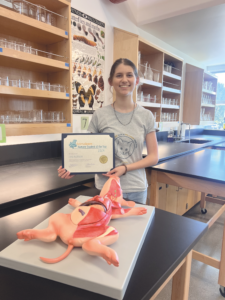
The evolution and expansion of technology means the development of more realistic models, innovative technologies (such as AR and VR), mobile apps, and interactive anatomy tables and tablets. Studies demonstrate that students who learn anatomy and other subjects using nonanimal methods perform just as well or better than students using animal specimens.
Animalearn’s The Science Bank helps educators and students nationwide put the life back in life science. As long as animals continue to be used for educational purposes, Animalearn will continue to provide humane alternatives.

 Nicole Green, MA, is the Director of Animalearn.
Animalearn.org
TheScienceBank.org
KindFrog.org
Photo courtesy Livia Aschheim, a CA high school student and Animalearn’s 2024 Humane Student of the Year.
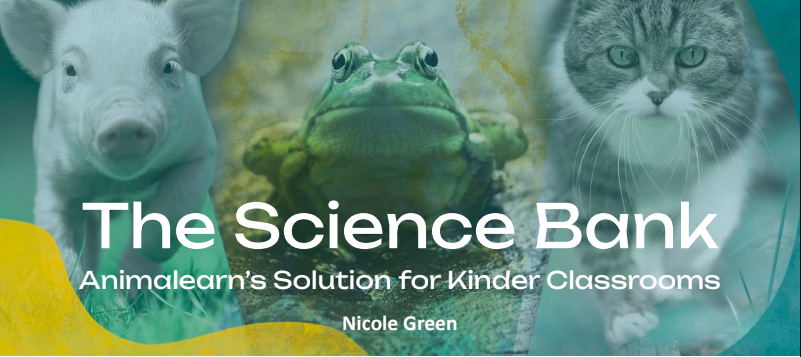
cat© furryfritz | Adobe Stock,
frog © Austin Santaniello | Unsplash,pig
© byrdyak | Adobe Stock