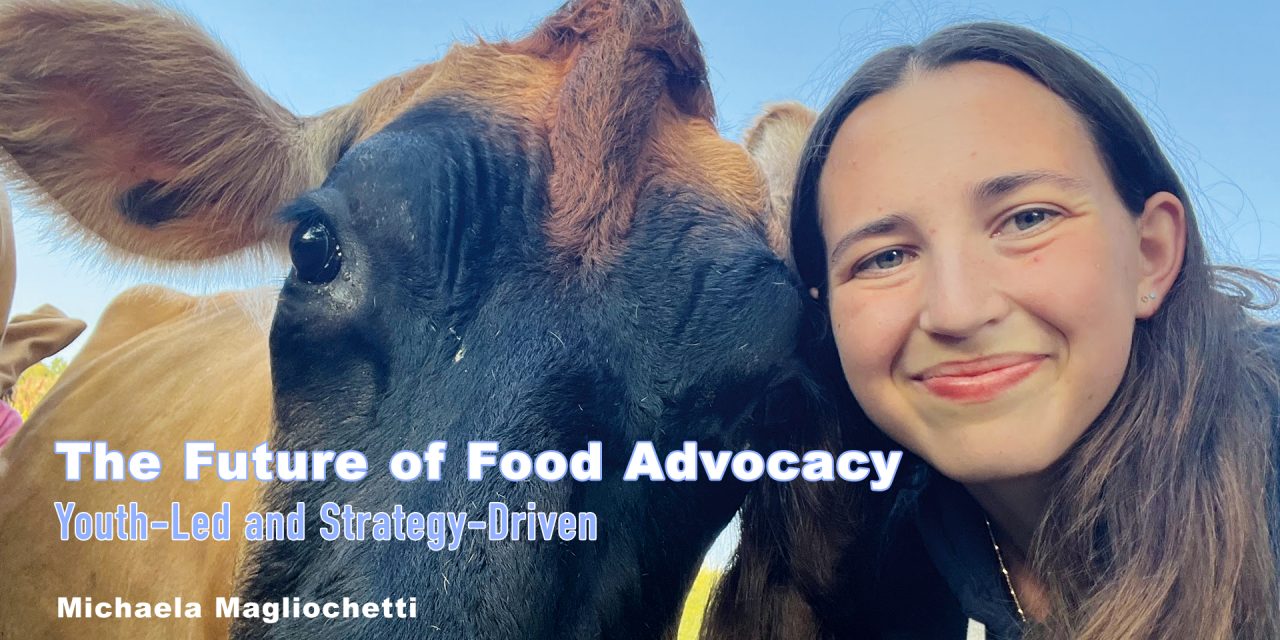
In addition to balancing academics and extracurriculars, an emerging group of student advocates has another item on their agenda: building an ethical and sustainable food system. Under the mentorship of New Roots Institute, a nonprofit empowering the next generation with knowledge and training to end factory farming, young leaders are learning to channel their compassion into campaigns that normalize plant-based eating and reduce consumption of animal products. During New Roots Institute’s summer Leadership Academy, fellows examine the environmental, ethical, and societal impacts of industrial animal agriculture, along with the interventions to counter them. They then continue in the Academic Year Fellowship, which offers personalized coaching and project grants to support them as they lead advocacy campaigns in their communities, from expanding plant-based cafeteria options to influencing food policy. Alumni continue to mentor fellows and peers, cultivating a network of advocates working across institutions, sectors, and countries. Meet five New Roots fellows and alumni who are shifting the status quo from their campuses outward. Their motivations are varied—climate change, public health, animal rights, and education—but they share a commitment to bring about a plant-based food system.
Inclusive Dining at Cornell
On a rocky isle six miles off the coast of Maine, Jessica Cohen’s compassion for animals turned into advocacy. Enrolled in Cornell University’s (Ithaca NY) marine biology program, she grew uneasy with the treatment of animals in her field research. She founded the Animal Advocacy Club at Cornell and later joined New Roots Institute’s Leadership Academy, where she began mapping out systemic dining changes to implement at the university. Cohen’s first campaign formed after listening to students lament about plant milk prices. “Many people— even those who weren’t vegan—were upset that it cost up to a dollar extra for oat milk in their coffee,” she said. Alongside New Roots fellow Lilly Smith, and with guidance from Better Food Foundation, Cohen spent months persuading dining staff to remove the dairy default and oat milk surcharge across campus cafés. Bolstered by student feedback and data on sustainability, they made their case—and won. The results were remarkable: oat milk purchases at Cornell doubled, signaling that students were eager for more inclusive options. For Cohen, the win wasn’t just about making one product more accessible. It was about creating a broader culture of inclusion where students can make ethical and health-conscious decisions without feeling burdened by extra costs. Cohen kept up the momentum by advocating for plant-based snacks at campus retail stores. Knowing the university was committed to sourcing local products, she curated a list of vegan brands within 200 miles of campus. During her senior year, Cohen directed UPGRADE Dining, a student-led coalition with 14 New Roots Institute fellows among its members, urging more than 30 universities to replace half of their animal-based food with plant-based options by 2030. “Students are the consumers,” she said. “I think campaigns are the most impactful when they’re led by someone within the system advocating for change. It just takes one student, one meeting. Anyone can create that change in their own community.”
American University’s First VegFest
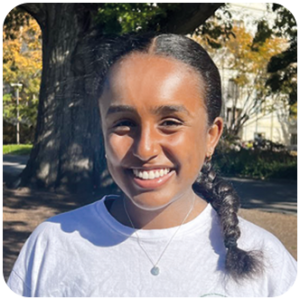
As a middle-schooler passionate about the environment, Rebecca Zewdie struggled to find community in Edmond Oklahoma. That sense of isolation faded when she stepped onto the American University (AU) campus in Washington D.C. last year. There, she met Sophie Cazares, founder of the AU Animal Rights Coalition. Zewdie became president of the Plant Futures AU Chapter, a student-led initiative focused on building a plant-centric future. Both Zewdie and Cazareswere enrolled in New Roots’ Leadership Academy and formed a close advocacypartnership through the program. They started by planning AU’s first VegFest.For Zewdie, the festival was a chance to reframe how plant-based food—and those who choose it—are perceived. “There’s this idea that plant-based food is bad or uninteresting,” she said. “It’s not only untrue. It’s harmful.” The dishes at the festival told a different story: vegan carne asada tacos from The Vegan Factory, Asian-fusion bites from PowPow, and Caribbean-Southern plates from Lovelei Duo were so popular they sold out before the event ended. Meanwhile, advocacy groups like New Roots Institute, Farm Animal Rights Movement (FARM), and DC Voters for Animals (DCVFA) offered students thoughtful ways to engage in food system activism. With more than 400 students in attendance, the event sent a clear message to campus staff: the appetite for plant-based options is real and growing. “These events help build on bigger campaign goals, like changing what’s in the dining hall,” said Zewdie. This spring, she organized an Earth Day festival. She hopes to continue hosting events that spark cultural change by meeting people where they are (and offering them a vegan cookie).
Putting Plants on the Menu in Morristown NJ

In an age when digital communication eclipses face-to-face chats, striking up conversations with strangers can feel daunting. But these chance connections are what Raizzi Stein attributes to her campaign successes. New Roots Institute’s Leadership Academy grounded Stein’s passions into a concrete plan for change in her hometown of Morristown New Jersey.“I wanted to work locally, make an impact, and connect with people who understood why this issue mattered,” she said. “New Roots helped me find my place in the movement.” During the Academic Year Fellowship, Stein planned and implemented an Eat for Impact Initiative: a program developed by PlantedSociety that equips organizers with tools to work with local restaurants, elected officials, and community leaders to advance plant-based solutions for climate action. New Roots Institute fellows across the globe took part in the Eat for Impact ‘Leadership Series’ and partnered with local restaurants to introduce two plant-based dishes on menus for one month.“I cold-called and emailed, but visiting the restaurants in person made it easier to get staff on board.” Her outreach not only led to lasting partnerships with restaurant chefs and owners but also earned her a Certificate of Acknowledgement from Morristown Mayor Tim Dougherty and New Jersey Senator Andy Kim. For Stein, the menu shifts are a step toward normalizing plant-based dining, encouraging non-vegans to try something new, and making vegan diners feel thoughtfully included. “When someone tries a plant-based dish they love, it opens the door to deeper conversations about sustainability,” she said. “That curiosity can lead people to do their own research about the realities of factory farming.” Across ten participating restaurants, Morristown Eat for Impact saved an estimated 25,631 pounds of greenhouse gas emissions (the equivalent of driving across the United States and back nearly five times), 333,000 gallons of water (enough for one daily shower over 43 years), and 93 acres of land (sufficient to grow vegetables to feed 2,000 people for a year). “People are becoming more aware that we’re in an environmental crisis. Bringing a reusable water bottle or taking a shorter shower is great,” she said. “But we need to normalize the idea that the way that we’re eating is causing a problem.” Stein says her her goal wasn’t to turn the town vegan, but to raise awareness—one dish and one conversation at a time.
Classroom Lessons Shift Perspectives

For Calvin Baguma, understanding the food system was an urgent call to action. “When I learned how factory farming has contributed to massive de-forestation in Brazil, especially in the Amazon, I was deeply alarmed,” he said “My country, the Democratic Republic of Congo, holds the second-largest rain-forest in the world. I felt a strong sense of responsibility to prevent similar harm in my region and protect our natural resources.” Baguma discovered New Roots Institute while searching for organizations focused on food justice and animal advocacy. The Leadership Academy gave him the tools to begin food system education in his community. “In many Congolese communities, meat is seen as a symbol of status or health,” he said. “Promoting plant-based alter- natives requires sensitivity and community dialogue.” His approach to empower others has proven both effective and rewarding: “After one of my workshops, a student came up and told me that his grandmother used to say that the secret to her longevity was being vegan. He thanked me for helping him reconnect with the values his family once cherished. That moment made me realize how powerful it is when advocacy revives ancestral wisdom and inspires action.” After engaging in his lessons, more than 40 students expressed interest in applying to New Roots Institute’s Leadership Academy. Baguma recently represented the next generation of Congolese at the 18th & 19thUN Climate Conference of Youth (COY 18, 19), carried out a successful plant-based dining campaign on his campus, and launched Veg Congo, a thriving Facebook group that raises awareness about factory farming and plant-based living in the Congolese community. Though Baguma has spent hours teaching, he feels he is the one learning: namely, that his voice matters and that he has the courage to lead. He hopes his work empowers others to feel the same.
Phasing Out Classroom Dissections

In middle school, Livia Aschheim and her mother struck a deal: Livia could be vegan, but she would also take on the responsibility of cooking the family’s meals. Her advocacy has followed a series of clever, resourceful compromises ever since. During her freshman year at Cupertino High School (California), Aschheim encountered a science project that struck her as unnecessarily harsh. Students were asked to create “eco columns,” sealed soda-bottle ecosystems in which predator and prey were confined together. With no alternative but to accept a failing grade, she completed the assignment. But the experience lingered. She wrote a research essay to the science department, presenting evidence that fish have the capacity to experience pain and contending that students cannot be required to take part in projects that conflict with their beliefs. To her surprise, the faculty responded by removing the experiment from the curriculum. Next came the dissection of fetal pigs, although this time an alternative was offered: a 16-page paper to be written alone in the library. “I knew so many students were uncomfortable with dissection. But the other option was so unequal that no one joined me to write the essay,” Aschheim said. She was determined to ensure others wouldn’t have to face the same isolating choice. Rather than call for an outright ban, she crafted a practical upgrade. Aschheim discovered Animalearn, a humane science education program that loans non-animal dissection alternatives through a free initiative called The Science Bank and pitched the idea of using a synthetic pig to her teacher. Her first request was ignored, but the following year another teacher agreed to try the model—and later purchased it. Aschheim was named Humane Student of the Year by Animalearn, and the organization donated a pig model as part of the award. “Now we have two synthetic pigs, so we can have two groups who are dissecting them within the classroom, which will make it so much easier for students to feel included,” she said. Through New Roots Institute’s leadership development programs, Aschheim learned the power of appealing to her audiences. “It speaks to people to see more inclusivity in education,” she said. “It makes people feel respected to know they don’t need to go against their morals for a grade.” New Roots Institute hopes to mobilize a new generation of advocates with an approach that favors curiosity over confrontation. With every conversation sparked, every dish reimagined, and every norm challenged, these leaders are writing the next chapter of our food system. They know it won’t be shaped by the loudest voices, but by those willing to listen, adapt, and work together.
Michaela Magliochetti is the Marketing & Storytelling Specialist at New Roots Institute. Michaela has spent her career compelling digital audiences through written, illustrated, video, and audio storytelling. She aims to spotlight the web of inequities within the food system and to empower others to make compassionate choices. Photos courtesy of New Roots Institute. Jessica Cohen is on page 26; each other photo appears next to their section.
Article first appeared in American Vegan magazine, fall 2025 / winter 2026.
To become a member click here.